
As if Israel did not already have to contend with war on several fronts, and as it struggles—and apparently does not want to end those conflicts and other military confrontations—the Israeli government and its military chief have decided to open yet another front.
This time, though, the targets aren’t Iran or its Islamic proxies. Its enemies are two young Israeli filmmakers, Yuval Avraham and Rachel Szor, co-directors of a controversial documentary called “NAZA”— the Hebrew acronym for “collateral damage.” The film, which last week won a Special Jury Prize at the Venice Film Festival and received a 25-minute standing ovation from the audience, portrays alleged war crimes committed by the Israeli Defense Force during the war in Gaza.
The film features some two dozen soldiers and officers from the elite military electronic intelligence Unit 8200, appearing in shadow and speaking anonymously. They describe the IDF’s use of an artificial-intelligence system known as “Lavender” to identify and kill Hamas operatives at various levels of the organization, while causing the deaths of thousands—perhaps tens of thousands—of innocent civilians as collateral damage.
Lavender, according to the film and an April, 2024 story in The Guardian that cited Avraham as the first journalist to reveal it, is an AI-powered database that at one stage identified 37,000 potential targets in Gaza, based on their apparent links to Hamas and the Palestinian Islamic Jihad.
However, it was not a “killer robot” that independently decided who to bomb. According to the investigation, Lavender generated or flagged lists of people considered suspects, while the operational decision to strike was supposed to remain in human hands. It’s not clear, however, that it did.
The screening of the film, produced by The Guardian, which has not yet been released to the public worldwide and will probably not be screened in Israel, has caused an enormous uproar back home.
IDF Chief of Staff Lt. General Eyal Zamir has ordered an investigation into the two filmmakers on suspicion of defamation. He’s also making efforts to track down the interviewees and prosecute them for violating the military’s secrecy laws.
Zamir himself has not seen the film. According to the IDF spokesman, the filmmakers did not agree to his request that they allow him to view it in advance of its release. According to the spokesman’s statement, “the Chief of Staff determined that this was a deliberate attempt to directly harm the legitimacy of the IDF and the State of Israel, despite the IDF’s assertion that it operates in accordance with international law and its own ethical code and is making efforts to minimize harm to civilians.”

Uproar
Large sections of the Israeli public share the IDF’s anger, which still enjoys the status of a sacred cow in Israeli public opinion.
Culture Minister Miki Zohar called for the citizenship of the two filmmakers to be revoked. He claimed that the film was reinforcing a rampant international sentiment in which many, particularly in so-called progressive circles, embrace and praise Israelis whose work reinforces their hostility toward Israel.
The backlash from Israeli conservative sectors has been furious. Demonstrators identified with the far right, associated with National Security Minister Itamar Ben-Gvir, marched in a procession reminiscent of storm troopers near the home of Rachel Szor’s parents. Even centrist pundits i raged against the film on Israeli TV, calling the filmmakers traitors. There were even voices suggesting that they should be shot like rabid dogs.
And with Israel just five weeks away from general elections—perhaps the most consequential in the history of its fragile democracy—even opponents of Netanyahu’s corrupt government have joined the angry chorus.
At Haaretz, the beacon of Israeli liberal media, military affairs commentator Amos Harel wrote that NAZA could be interpreted as an allusion to years-long radical commentary which has compared Israel’s actions to those of the Nazis during World War II. NAZA, Harel said, could well be understood as an amalgamation of “Nazis” and “Gaza.”
The atmosphere of near lynching was somewhat tempered by a petition signed by a thousand Israeli filmmakers expressing support for and solidarity with the two creators on the basis of defending freedom of _expression_ and their artistic rights. A handful of journalists as well, some of them military affairs correspondents identified with a liberal agenda (including myself), wrote that the allegations of war crimes should be thoroughly investigated and that the witch hunt—characteristic of undemocratic, authoritarian societies—should stop.
Fear of Violence
Amid all this, Yuval Avraham wrote to me from somewhere in Europe, saying that he valued my opinion as a military veteran and experienced national security journalist. But he also admitted that he was shaken and frightened about the ramifications of the campaign of vilification and threats against him—whether his personal safety was in danger. Much of what was happening in Israel was “insane and extraordinary,” he said, adding, “I hope we can return to Israel. I don’t want to let them win.”
In an interview with Israeli Channel 13, Avraham was questioned about his ability to verify the claims made to him by soldiers and officers who spoke to him on condition of anonymity. He responded that their claims had been thoroughly investigated and verified, and that The Guardian also had access to the raw footage from the Gaza war. According to Avraham, both the identities of the interviewees and the incidents they described had been fact-checked.
It is doubtful that Chief of Staff Zamir’s campaign of retribution will produce the results he hopes for. At most, the IDF might sue the filmmakers for defamation under Israel’s libel laws. Such a lawsuit, however, could result in years of testimonies for and against the IDF being aired and examined in court, long after the controversy over film itself has faded from the news.
Identifying the leakers who were interviewed for the film could be even harder. They appear with their faces obscured and do not identify themselves by name.
By the time all the investigations and legal proceedings have run their course, the filmmakers, producers and distributors will have enjoyed enormous free publicity. The controversy will only amplify the film’s exposure and bring it to the attention of a much larger audience. In the end, Zamir and his advisers may end up becoming the film’s most effective publicists and marketing team.
If Zamir were acting wisely, rather than being driven by a desire to prove that he is right, he would have simply ignored the film and the hype surrounding it and allowed the storm to pass.
But the chief of staff is a captive of the Israeli zeitgeist, particularly its sense of victimhood, a fervent belief in Israel’s righteousness, a desire for revenge against its enemies, an unwillingness to examine facts and to apologize when necessary, and, of course, the inflammatory atmosphere of social media. In this maelstrom, Zamir has decided that he must satisfy the mob in the streets, in social media and, perhaps most critically, the far-right backers of Netanyahu’s fragile government coalition.
Hit Piece
I have not seen the film yet because Avraham and The Guardian want to control its release. But the impression I’ve gotten from talking with several people who have seen it is that the personal testimonies in it are indeed shocking, while the film itself is rather simplistic and largely devoid of historical context.
It says very little, for example, about the circumstances that formed the IDF’s furious response in Gaza following Hamas’s Oct. 7, 2003 massacre of 1,200 Israelis, its kidnapping of 251 more, its rapes of countless Israeli women and its looting and burning of Jewish homes in the communities surrounding Gaza.
According to my confidants, the film also lacks a rigorous examination of the concept of collateral damage, a term associated with the American economist and strategic thinker Thomas C. Schelling, who defined it in a 1961 paper as the unintended harm to civilians or non‑targeted assets.
Civilian casualties in wartime are, of course, as old as war itself. But during the Vietnam War “collateral damage” became a carefully sanitized phrase that obscured the careless, and sometimes even deliberate, killing of civilians. It’s become entrenched in the vocabulary of the U.S. armed forces ever since. In some ways, Israel, too, has adopted it.
During the 21st century wars of Afghanistan and Iraq, the United States military used numerical thresholds for anticipated non-combatant casualties when evaluating certain strikes. These thresholds could determine whether a commander in the field could authorize an attack or whether approval from higher political or military authorities was required.
The thresholds varied substantially between theaters of war and at different stages of the conflicts, depending on American political and strategic considerations. At the beginning of the Iraq war, for example, the threshold for anticipated civilian casualties in certain operations was reported to have been as high as 30.
The implication was that if an assessment indicated that a strike against a senior Iraqi target might kill fewer than 30 civilians, approval could be given at a lower level of command. If the anticipated number was higher, the decision required authorization from Defense Secretary Donald Rumsfeld.
In Afghanistan, the threshold was reportedly reduced dramatically, in some circumstances to a single civilian casualty. Yet in both theaters there were exceptional cases in which many dozens of civilians were killed.
The IDF has adopted the general concept, but it does not disclose its own thresholds for anticipated civilian casualties. This lack of transparency gives the military considerable room for factual flexibility and for justifying civilian casualties after the fact.
Chief of Staff Zamir’s decision—and his call for government ministries to push back against the film through “proper public diplomacy”—is rather pathetic.
Appalling Numbers
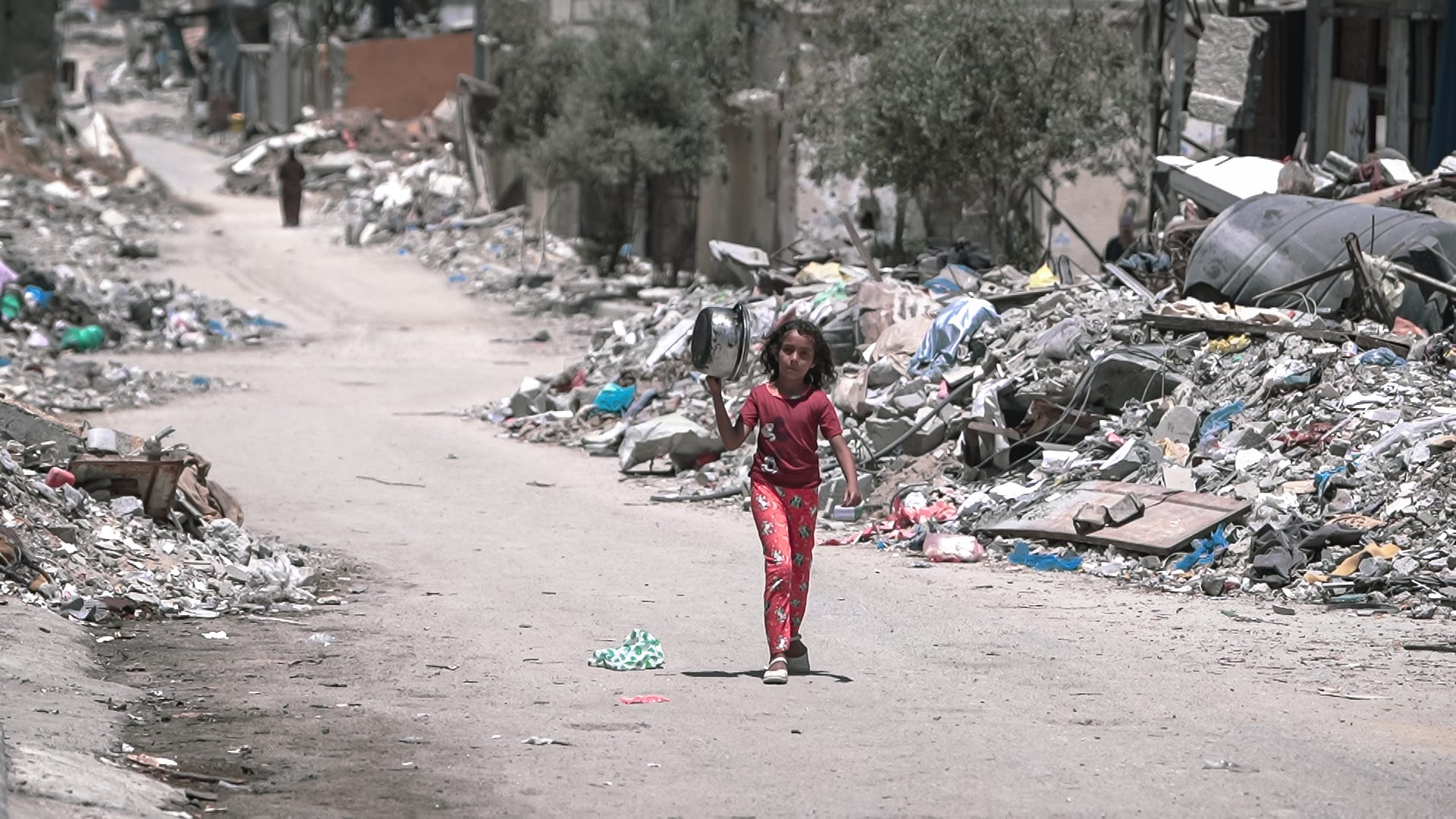
Even if you are fighting what’s deemed a just war, as against Hamas war criminals in Gaza, it becomes extraordinarily difficult to defend your conduct after your forces have killed approximately 70,000 people—around three percent of the population—including tens of thousands of women and children, while destroying or seriously damaging roughly 70 percent of the buildings where people lived. And then there’s the soldiers and officers, including some very senior ones, who have taken the law into their own hands in Gaza, as reported and revealed even in the Israeli media.
It didn’t take NAZA, of course, to damage Israel’s reputation as an embattled, noble democracy repeatedly forced to fight for its survival. That’s been happening for years now. But when senior Israeli ministers, members of the Knesset and former generals such as Giora Eiland call for Gaza to be flattened, or for nuclear weapons to dropped on it, or for its population to be starved to death, they themselves accelerate international sentiment that Israel is guilty of war crimes, or, in some quarters, genocide.
Israel has traveled a long road during its 75 years of existence, from a nation that saw itself as part of the democratic-liberal camp, championed human rights, and regarded itself as a light unto the nations. During its first decades, it pretty much successfully cultivated culture and science and presented itself to the world as a nation of pioneers and avatars of social justice —i.e., it used the tools of what’s known in diplomatic, military and intelligence circles as “soft power.” The foundation of its moral authority, of course, came from a people born from the ashes of the Holocaust, and their successful repulsion of repeated, if not constant, Arab or Iranian-backed assaults designed to remove them “from the river to the sea.” or to be “wiped off the map,” as Iranian president Mahmoud Ahmadinejad put it in a 2005 speech.
If the two IDF chiefs of staff who have run the Gaza war, Herzi Halevi and Eyal Zamir, had devoted even a fraction of the energy they have invested in denouncing the rest of the world to policing their own troops, investigating allegations of soldiers and officers suspected of violating orders and the laws of war, and punishing those who were judged responsible for war crimes against humanity, Israel’s standing in world public opinion might well be far, far better.
But, no. Today, no public-relations campaign—and certainly no punishment of journalists or documentary filmmakers—will erase the mark that has been stamped on Israel’s forehead for generations to come. ###